Monday, August 20, 2012

Well Worth It

Every once in awhile, Keith states that he needs a change of scenery. This past weekend was one of those times. Without a lot of planning, we headed out Sunday morning to Hopewell Furnace, a National Historic Site about 45 minutes away. Neither of us had ever been there before (and of course, Bert hadn't either) and it is always fun for us to go places that are new to all of us. Oh, and it never hurts if those places are free.


We arrived around 11:00 or so, having stopped for breakfast on the way. At the visitors' center, they were just starting a 15-minute film about the site so we slipped in quickly. The park ranger pointed out a basket of stuffed animals that we could grab to entertain Bert but he still only lasted about 5 minutes in the little theater so Keith took him out and looked at some of the displays while I watched the rest of the film. To sum it up, Hopewell Furnace produced iron goods, from cookstoves and household goods to cannons used in both the Revolutionary and Civil Wars. It operated until 1883, when it could no longer keep up with more modern steel production. The site was more or less abandoned for the next fifty years, until it was restored as a Civilian Conservation Corps project. Pretty much all the buildings are open to the public and there are demonstrations on weekends as well.

I think this was the cooling shed, where charcoal was brought from
the woods to the furnace.

The ironmaster's mansion

The ironmasters' mansion has 19 rooms, several of which you can view on the first floor.


I didn't notice anything about guided tours but visitors are free to walk all over the grounds.

The company store

The barnyard was fascinating to Bert.


Behind the house there was a spring house with water running through it. The sign said it was where they did laundry and butchering.


Looking down into the spring house
There was also a blacksmith's shop, with a gentleman doing demonstrations and explaining the differences between different kinds of iron (cast, wrought, steel, etc.). It was full of all kinds of tools.


A pretty little stream running through the site.
The furnace workers and their families rented homes from the furnace owner and lived nearby. Several of the homes are intact and one was furnished for viewing. The sign invited visitors to pick up and touch anything in the house as everything was replicas.


At 12:30, there was a demonstration in the furnace house showing how the workers made sand molds and explaining how the furnace operated. They told us that the furnace took three weeks to reach temperatures hot enough to make iron and when it was ready to be poured, a bell would ring and the molders would rush to the building to fill their molds. 


This is where the term "pound sand" comes from.
Really, I'm being serious.

A mold for the door of a woodstove. Hopewell Furnace had 23 models
and sizes of wood and cookstoves at its peak. An experienced worker could
mold 3 stoves in 2 days while the furnace was running.
The opening to the furnace where the iron
poured out.

Ladles for dipping the hot iron as it came out of
the furnace.

Iron that couldn't be put in molds fast enough was run out into troughs
as pig iron.
I think my favorite part was the huge waterwheel at the back of the furnace house.


Bert was pretty impressed too.


Bert plays with a cannon.
Hopewell Furnace tried to modernize their production by switching to an anthracite coal-fired furnace but after 4 years of disappointing results, it was shut down.


You can walk all through the coal furnace ruins.
Hopewell Furnace was heated with charcoal, made from the wood in the surrounding forests. The furnace consumed 5000 to 6000 cords of woods a year, all chopped by hand and made into charcoal in charcoal pits like this one. It looked like they must do demonstrations here sometimes.


The people who tended the charcoal pits in the woods (I think they were called colliers) lived in primitive huts that looked something like this. A collier could tend several pits at once and sometimes as many as three would live together in a hut so they could tend up to nine pits at a time.


There were some other really interesting things we learned, like for most jobs, men and women worked side by side, as did blacks and whites. Hopewell Furnace had "equal pay for equal work," so they were pretty progressive for their time in terms of equality. Interestingly enough, when it became a CCC project, blacks and whites worked separately. 

I think on Saturdays they do a demonstration where they heat up a smaller furnace and melt aluminum and cast it in the molds, which would be neat to see. It's worth checking out their website and reading up on what events are going on, like apple picking in the fall, and other trails you can walk. We had a nice time and were happy to wander around on our own (rather than worry about Bert getting antsy on a tour) and think this would be a great place to go back to when he is old enough to be learning some of these things in school. We spent almost three hours there, which seemed like plenty of time to do what we wanted but you could make a longer day of it with the trails and other demonstrations.

Wednesday, August 15, 2012

Christmas in August

Did you hear my sigh yesterday? The one of relief, and of accomplishment? You know the one, when you finally finish a project that has been dogging you for months.

You saw when Bert's stocking looked like this:


And I thought I did a post when I finally finished the cross-stitching but I must be confusing writing a post with ecstatically showing it to anyone who came to the house or we went to visit (because I know I took it to my parents' when it was done). Anyway, sometime in the late spring, I was done stitching and on the hunt for fabric to line and put a back on the stocking. 

I had in mind that I wanted some kind of vintage toy or train pattern but after looking high and low (read: fabric stores around home, and fabric stores in Maine), I couldn't quite put my hands on what I wanted. Then I was talking with my neighbor about my fruitless search and she said she thought she might have some train prints around. She brought over a few fabrics and after looking at them for a bit, I decided I really liked the one train fabric for a lining paired with the fabric from Bert's weekly photo in the wagon for the back of the stocking.

I was more than a little nervous about cutting out the stocking after spending a zillion hours cross-stitching, so I put it off for awhile. Finally, yesterday, after tripping over the pile of fabric for the umpteenth time in my office, I decided it was time to get it done. 

I started about by tracing the stocking shape from my pattern book onto parchment paper (in lieu of tracing paper).


Then I decided the parchment paper was too flimsy for my liking to cut four pieces from (front, back, and two pieces for the lining), so I transferred it to an old gift box to make a sturdier pattern.


Then I traced it on my back and lining pieces and confidently cut away.


Now it was time to move on to the front piece, with all that labor-intensive stitching. Here I pinned down the parchment paper pattern, which was nice to work with because then I could see through it and make sure I liked how it laid on my stitched piece before cutting.


Then I oh-so-carefully traced it on. I wish I had a fabric marking pen that would have washed out if I messed up but I was on a roll so I just used a regular ballpoint pen. Very bold, I know.


And now is about the time where I was very engaged in what I was doing and not so good about taking pictures. To sum it up, I cut out all the pieces, sewed the lining together with a 1/2" seam, and the front and back with a 3/8" seam. The lining was left wrong-side-out and before sliding it in the stocking, I trimmed it really close to the seam so it wasn't as bulky (this is me, actually reading and following the instructions from the book for finishing the stocking). Then I clipped around the outer stocking piece before turning it right-side-out. On both pieces, the top edges got folded down a 1/2" and ironed to leave a finished edge at the top. Before sewing them together, I made a little loop for hanging by cutting a strip of the same fabric I used for the back, folding it in half, sewing up one side, and turning it right-side-out. Then I sewed it to the inside of the back piece at the left side seam.

Got that? Because this photo now seems really random and useless in terms of explaining what I was doing.


The final step was putting the lining inside the stocking and sewing the two together, with, as the instructions said, a blind stitch. Which means proceed blindly because you don't know for sure what you are doing, right? Actually, I could handle that part pretty easily, just making the stitches in between the top edges, attaching them where each was folded down. It just took awhile because it had to be done by hand.

So what I had been putting off for months was finished in a little over an hour, and I didn't royally mess it up or anything. My stitching on the heal and toe weren't quite as rounded as I would have liked, but I was worried it would just end up worse if I tried to pull the stitches out and start over. And I just realized I didn't get any pictures to give you an idea of what the lining looked like so stay tuned for the Christmas post and maybe you can catch a glimpse of it when Bert yanks gifts out.


Bert gave his approval and did me a favor by looking interested and trying to run away with his stocking, which I snatched out of his grubby little hands before he got it dirty. I think he will be much more excited come Christmas morning when it is filled with goodies.

Tuesday, August 14, 2012

Happily Ever After

Time for a Quarter-Acre Challenge!

Question #1: Who are these young kids? (Hint: Not Keith and me.)


Question #2: How long have they been married?

Answers:

#1: My parents. (Bet most of you already knew that, since only about six people read this that aren't family.)

#2: Thirty years, today.

Happy Anniversary, Mommy and Daddy!

Friday, August 10, 2012

A Little Corny

Sorry folks. We're back to recipes. It has been a slow, unproductive week with nothing exciting to report, except that Bert is feeling better.

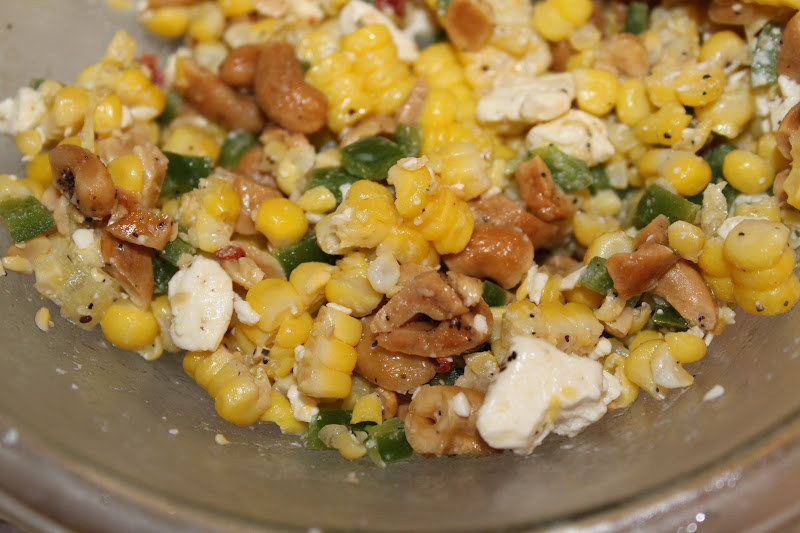
I pulled this recipe out of a Real Simple magazine several years ago and have made it every summer since. It was great for when I would buy a half dozen ears of corn and we would only eat two with dinner, then I would make this salad with the rest.


Corn Salad with Feta and Walnuts
Real Simple

1 c. walnuts (I used cashews the last time I made this)
4 c. fresh corn kernels (4 ears), raw or cooked (I use cooked)
2 jalapenos, seeded and thinly sliced (I use bell peppers, finely chopped)
2 Tbsp. fresh lime juice (lemon if that's what I have)
2 Tbsp. extra virgin olive oil
salt and pepper
1/2 c. crumbled feta

Heat oven to 400 degrees. Spread walnuts on a rimmed baking sheet and toast until fragrant, 6 to 8 minutes. Let cool and roughly chop. In a large bowl, combine the corn, peppers, lime juice, oil, walnuts, 1/2 tsp. salt and 1/4 tsp. pepper. Sprinkle with feta before serving.

You can't beat fresh corn on the cob, with butter, salt, and pepper, but as far as dressing up leftovers, this is one of my favorite ways to do it.

Tuesday, August 7, 2012

What's Going On

Are you thinking the same thing I am? That you need a break from recipes and would prefer a little update? Yeah, me too.

The garden is moderately abundant (is that an oxymoron?), with plenty of produce coming on, but it seems like never enough of one thing to do anything with. I was looking forward to trying out my pressure canner on some green beans, but even with a friend's extras, I only had six 6 cups and it just wasn't worth the bother for three jars. Option B: blanche and freeze. I feel like I am holding my breath, waiting for the tomatoes to overrun us. I picked some yesterday but again, not enough to do sauce with. We lost a lot to blossom-end rot, but the ones that are ripening now are looking better. What we did have a lot of was corn. I headed out late last week, thinking there would be a dozen ears or so to pick and cut off to freeze raw. I ended up pulling 49 ears and doing corn like my mom does, cooking with sugar before freezing.

Over the weekend, we went to my family reunion, which was a lot of fun. Bert got to be the center of attention, and I got a break from chasing him around. He really enjoyed helping to feed the fish at the recently stocked pond (bass and blue gills, I think), and even tried to sample a few of the fish pellets himself. All that excitement must have worn him out, because he slept really well for being in a different place.

Every Monday through August, I am leading the baby lapsit story time at the library. Bert and I have been going pretty regularly since he was about  two weeks old. The librarian that had been doing it (and doing a fantastic job) left for another position, so they asked for volunteers until a new librarian is hired. She left some big shoes to fill, but thankfully the under-4 set is a forgiving audience and the other moms know the words to all the songs.

Monday night was my first meeting as a member of our borough's Environmental Advisory Commission. A friend asked if I would like to join, and I had been thinking for awhile that I needed to get more involved in the community. This seemed like the perfect fit for me, since they help shape policy for the borough with regards to environmental concerns. There was no election, but I did have to get approved and appointed by the borough council and am considered an appointed official. Sounds very important doesn't it?

But just when you think things are going great...

Bert and I were getting ready to head out for a walk this morning, to enjoy one of the few pleasant mornings we've had this summer, when he threw up all over himself, me, and the living room carpet. I didn't know where to reach first and it just kept coming. I tried to get to the dining room for some napkins and really only managed to get more of the mess in more of the house, so I finally gave up and carried him up to the bathtub, stripped him down, rinsed him off, cleaned myself up, and laid him down. He slept for awhile and I cleaned up the mess. When he woke up, I kept giving him a little bit of water every ten minutes or so. He was really cranky so he was only up about an hour and a half before I put him down for another nap. After his nap, it was more fluids and since he was keeping them down, a little bit of dry cereal. By dinner, I thought we were in good shape so I gave him part of a piece of toast. Keith suggested we go for a walk so I took Bert out and put him in his stroller. He was all strapped in and then, you know what's coming. He got sick all over again. So I stripped him down in the yard, Keith grabbed some wet paper towels, and we cleaned him up. Then he played happily outside while Keith hosed off the stroller. You would think baby gear would be made with removable, washable cover. Not so. Keith ran to the grocery store for some Pedialyte to make sure Bert was getting something in him. After a couple small rounds of that, it was off to bed. Here's hoping tomorrow goes a little better and doesn't involve a trip to the doctor's office.

Thursday, August 2, 2012

One Potato, Two Potato...

...Three potato, salad!

Keith dug up our potatoes the other week, and since there weren't too many of them, we didn't go through all the bother of blanching and freezing them like last year. We did have a lot of small ones though, ranging from nickel to half-dollar-sized and perfect for making potato salads. Lucky for me, I had recently cut out two recipes I wanted to try.

First up,

Herb Potato Salad
Real Simple, May 2012


1 1/2 pounds new potatoes (about 15), halved if large
1/2 cup chopped fresh herbs, such as parsley, tarragon, and chives (I used chives and basil)
2 scallions, thinly sliced (I just used a thinly-sliced small onion)
2 tablespoons olive oil
1 tablespoon whole-grain mustard (we had spicy brown on hand)
1 tablespoon red wine vinegar
salt and pepper

Fill a large saucepan with 1 inch of water and fit with a steamer basket; bring the water to a boil. Place potatoes in the basket, cover, and steam until tender, 12 to 14 minutes.

Meanwhile, in a medium bowl, mix together the herbs, scallions (or onions), oil, mustard, vinegar, 1/2 teaspoon salt, and 1/4 teaspoon pepper. Add the cooked potatoes and toss to combine.

It was that easy. I forgot to take a picture of that one, but I did get one of the second dish:


Potato Salad with Green Beans & Ricotta
Whole Living, July/August 2012

Scrub and halve 2 lb. small mixed potatoes. Cook them in a pot of well-salted boiling water until tender but not falling apart, about 9 minutes. Add 8 oz. green beans trimmed to 1" pieces during last 3 minutes of cooking and cook until just tender. Drain and immediately toss with 3 Tbsp. olive oil and the grated zest and juice of 1 lemon. Let cool slightly, then stir in 1/2 c. ricotta and 1/2 c. chopped fresh dill. Season with salt and pepper.

Both recipes were simple and delicious. The second one was great for using up some green beans when there was only a handful ready, but I think my favorite was the first. I can see making it again and again because I almost always have everything on hand for it. 

Related Posts Plugin for WordPress, Blogger...