
Showing posts with label Ex Libris. Show all posts
Showing posts with label Ex Libris. Show all posts
Tuesday, July 3, 2012
Putting the "Ex" in Ex Libris
Have you noticed that I really fell off the wagon with the book reviews? I thought I would enjoy writing them when I started but found that I really didn't. I would stack up books next to my desk as I finished them, putting off writing about each of them to the point where I had a big pile and no motivation. So you know what? I'm letting myself off the hook on this one. If I read a book that really moves me, or seems to be in line with the things we write about on this blog, then maybe I'll do a review. Otherwise, I'm just going to use the Ex Libris page to keep a running list off what I'm reading. I might put a sentence or two about the book if I enjoyed it, and I'll definitely let you know if I think it is one you can skip. Feel free to pop over there and see if there's anything that interests you!


Monday, May 7, 2012
A Promise Kept

Promise Me
How a Sister's Love Launched the Global Movement to End Breast Cancer
By Nancy G. Brinker with Joni Rodgers
(I originally said May is Breast Cancer Awareness month but Keith clued me in that it is actually October. Somehow a room full of women got that mixed up when we decided this would be the perfect book for May. Maybe we were thinking that May means Mother's Day and we all want our mothers and grandmothers to be cancer-free.)
The book club at the library that I participate in chose Promise Me as our May book. We all know the name Susan G. Komen, but prior to reading this book, I had no idea it was her sister, Nancy G. Brinker, who founded the organization to raise awareness and fund research for breast cancer treatments. Brinker weaves the story of her life, of her sister's devastating diagnoses, and the birth and growth of the foundation in an informative and moving memoir.
Despite centering on the heartbreaking topic of breast cancer, Promise Me is hopeful and engaging. Each chapter about the sisters' lives is balanced with a shorter chapter celebrating the researchers and survivors of breast cancer or honoring those who have died of the disease. Clearly, Brinker views the fight against breast cancer not just as a personal one, but as a universal cause. Brinker writes honestly about the struggles in her life, with her relationships, her own diagnoses of breast cancer, and the differing opinions of effective treatments and research in the search for a cure.
The one part that really sticks in my mind is that though Susan G. Komen is in it for the long haul, they haven't constructed their own building for the organizations headquarters because they have no intentions of needing to be around for decades. They expect to find a cure.
Wednesday, April 18, 2012
Upstairs, Downstairs

The House at Riverton
By Kate Morton
I've been hearing a lot about the show "Downton Abbey" on PBS, but I have only managed to catch one episode. I was intrigued, but since it is listed as "Masterpiece Classic" on the channel guide, it never catches my eye as I surf through the guide, eventually settling on something like "Doomsday Preppers."
That one episode of "Downton Abbey" was on my mind as I started to read The House at Riverton. Both take place on large English estates, intertwining the lives of the servants "downstairs" and the masters and mistresses of the house "upstairs" in the early part of the 1900s. Riverton is home to the Hartford family, with lively daughters Hannah and Emmeline taking center stage. Their ladies' maid, Grace, is a keen observer in their lives, never guessing that she will have a hand in how their lives and ultimately, the tragedy that befalls them, unfold.
Grace has pushed her years with the Hartford family aside, desperately trying to move on with her life. It isn't until a filmmaker approaches her about her memories of the death that occurred at a Riverton party that she revisits the estate and the events that shaped her life, revealing its mysteries in her final days.
The House of Riverton is full of secrets and questions of loyalty as the characters try to find their place in the world, and question the roles society has burdened them with against the backdrop of World War I and the glamour of the upper class.
Sunday, April 15, 2012
Twi-what?
I read the first Twilight book because my neighbor loaned to me. When I was finished, I looked at the rest of the series she had handed over and decided I had better things to do with my time than read a few more thousand pages about teenage vampires. What better things did I have to do, you ask? Apparently, read 766 pages about adult vampires.

Loaned to me by the same neighbor, I will admit I was a bit wary of another vampire book. But, she told me that several of the readers in her family had enjoyed The Passage even though science fiction isn't usually their cup of tea. Ok, I was game. It's a book, I like to read, and there isn't much I won't crack the cover on.
The vampires of The Passage are called virals, and it all starts with a US Army Special Weapons research project. Death row inmates are injected with a virus strain from deep in the jungle that makes them into a super-human creature. When they attack humans, their prey either dies or, in approximately one out of ten cases, transforms into a viral. I'm sure you can see where this is going. The virals escape their secret test facility and make their way into the world, the virus spreading rapidly despite quarantine zones and military action. Some of the age-old vampire fighting tactics still hold, like shooting them through the heart, garlic, and light.
Fast forward nearly 100 years, and the story centers on a group of survivors at a compound in California. They have fended off the virals for decades and created their own pocket of society, not knowing if there are any other humans left. They live in a world the blends colonial practices of farming and weaponry with the leftovers of modern times, patching together a light system with electricity off the deteriorating grid to keep the virals away at night. As their batteries begin to fail, the virals strengthen, and a strange young girl shows up at the compound, the tight-knit community begins to self-destruct. A small group sets off from the compound to try to solve the mystery of the virals and discover what has become of the rest of the world.
Did it get a little far-fetched? Of course it did; it's science fiction. But that might have been what kept me interested: it was so far off the beaten path of story-telling that I was constantly surprised by how the story unfolded. The characters were believable, even if they existed in a world outside the scope of my imagination. The pace of the book was just right, not rushing through parts nor getting bogged down in details so it kept me turning pages.
Are you intrigued? I was. And guess what? In the new standard of vampire stories, there will be a sequel! (Apparently, all vampire stories need to be long and in multiple parts because vampires never die. Never.) I liked this well enough that I will probably read the next one, which is due out in October. You might say I've been infected.

The Passage
By Justin Cronin
Loaned to me by the same neighbor, I will admit I was a bit wary of another vampire book. But, she told me that several of the readers in her family had enjoyed The Passage even though science fiction isn't usually their cup of tea. Ok, I was game. It's a book, I like to read, and there isn't much I won't crack the cover on.
The vampires of The Passage are called virals, and it all starts with a US Army Special Weapons research project. Death row inmates are injected with a virus strain from deep in the jungle that makes them into a super-human creature. When they attack humans, their prey either dies or, in approximately one out of ten cases, transforms into a viral. I'm sure you can see where this is going. The virals escape their secret test facility and make their way into the world, the virus spreading rapidly despite quarantine zones and military action. Some of the age-old vampire fighting tactics still hold, like shooting them through the heart, garlic, and light.
Fast forward nearly 100 years, and the story centers on a group of survivors at a compound in California. They have fended off the virals for decades and created their own pocket of society, not knowing if there are any other humans left. They live in a world the blends colonial practices of farming and weaponry with the leftovers of modern times, patching together a light system with electricity off the deteriorating grid to keep the virals away at night. As their batteries begin to fail, the virals strengthen, and a strange young girl shows up at the compound, the tight-knit community begins to self-destruct. A small group sets off from the compound to try to solve the mystery of the virals and discover what has become of the rest of the world.
Did it get a little far-fetched? Of course it did; it's science fiction. But that might have been what kept me interested: it was so far off the beaten path of story-telling that I was constantly surprised by how the story unfolded. The characters were believable, even if they existed in a world outside the scope of my imagination. The pace of the book was just right, not rushing through parts nor getting bogged down in details so it kept me turning pages.
Are you intrigued? I was. And guess what? In the new standard of vampire stories, there will be a sequel! (Apparently, all vampire stories need to be long and in multiple parts because vampires never die. Never.) I liked this well enough that I will probably read the next one, which is due out in October. You might say I've been infected.
Tuesday, March 27, 2012
Home and History

Red House
Being a Mostly Accurate Account of New England's Oldest Continuously Lived-In House
By Sarah Messer
Shortly before Sarah Messer was born, her parents purchased "Red House," a home that had been owned by nine generations of the Hatch family near Marshfield, Massachusetts. For over three hundred years, the house had been passed down through the family, as stipulated in the will of Walter Hatch, who built the house. Messer and her siblings grow up among the relics of a family they aren't descended from, with old photos of the Hatch family hanging on the walls and letters and linens passed between the Hatches crowding the closets. The house is often somewhere between a state of disrepair and renovation, as layers and years are peeled back, revealing the evolution of the home with each new owner and era.
The book explores the history of the house and of the Hatches, while weaving in the story of the Messer family. As a child, Messer didn't realize it was strange to live in a drafty house with few modern amenities and no wall-to-wall carpeting until she started to going play at friends' houses. As an adult, she questions what right her family has to Red House, when there are still Hatch descendants interested in the property. She helps to restore the house, and becomes interested in documenting its story and establishing a timeline of its life. As she says in the epilogue, the house has no baby book and cannot speak for itself, so this book is her attempt at giving it a voice.
I picked this book up at a thrift store for a quarter and I'd say it was worth it. It's interesting for me to think about how when family and place get so tied to each other, what happens to the family when the place is gone? At some point, it seems that the place becomes another member of the family, and in the case of the remaining Hatches, when Red House was sold, it was almost as if they had lost a close relative. Messer's memoir goes beyond the history of a home to explore the meaning of place and how we draw on history, both of family and culture, and place to create our own identities.
Friday, March 16, 2012
Don't Forget to Read This One

The Forgotten Garden
By Kate Morton
Right from the start, The Forgotten Garden had me hooked. Kate Morton tells the tale of Nell, a young girl arriving alone in Australia, fresh off a boat from England. Taken in by the dockmaster, she isn't told about her mysterious arrival until she turns 21. She is drawn back to England to search for her past and her family, only to leave it all behind again when she has to raise her granddaughter, Cass. After Nell's death, Cass picks up the threads of her grandmother's story and attempts to put it all together.
The story spans generations, decades, and continents and manages to never lose it's focus. Each chapter takes a different perspective and time period, from Nell's arrival in Australia in 1913, to her return to England in 1975, Cass's own trip to England in 2005, as well as the years before Nell's ship sets sail from England. The reader finds out bits of Nell's history as first she, and then Cass, trace the origins of a book of fairy tales Nell carried with her on the ship. Nell's notes drive Cass closer and closer to solving the mystery of her family, and the reader is privy to the lives of Eliza and Rose, cousins growing up on Blackhurst Manor in England, and a chain of events set in motion that they could have never imagined.
The use of fairy tales as a strong element in the plot reminded me of Winter Garden. In The Forgotten Garden, the fairy tales are written by one of the characters and serve as powerful clues to the truth behind Nell's past. Though fairy tales were a large part of the story, the central themes of mothers losing children and children losing mothers were what bound the story together and made the development of the story over several generations work. As each woman searched for her past, the discoveries she made filled a void in her life, even as she least expected it.
Tuesday, March 6, 2012
A New Spin on Vintage

A Vintage Affair
By Isabel Wolff
A Vintage Affair is the March pick for the library book club and I think this one will be a crowd pleaser. The book centers around Phoebe, the owner of a newly-opened high-end vintage clothing shop. She opens the shop after the devastating loss of her best friend and the dissolution of her engagement. As she searches for articles of clothing for the shop and greets customers, she meets people who help her to move past the tragedies in her life and embrace the possibilities of the future.
Isabel Wolff's characters were genuine and believable, and the story unwound naturally, at times sorrowful and then heartwarming. I loved the way the shop full of vintage clothing drew the characters to one another, almost becoming a character itself. It made the relationships between characters of all different ages pull together seamlessly, and the past and present mingled easily. A Vintage Affair wasn't a long book, but Wolff fleshed out the connections between Phoebe and a handful of minor characters in a way that crafted and deliberate, not hurried or added as an afterthought. I thought it was charming and engaging, with a weighty enough story that I didn't feel like I was reading fluff.
Tuesday, February 28, 2012
Funny and Fast

Why My Third Husband Will Be a Dog
The Amazing Adventures of an Ordinary Woman
by Lisa Scottoline
Having been the recipient of several of Lisa Scottoline's columns, clipped from The Philadelphia Inquirer and mailed to me by my Mom-mom, I figured that it was a safe bet that I would enjoy this collection of her columns. I was right on the money. Her witty observations and fast delivery made this a quick and fun read. She reminds me of Seinfeld, only based in the suburbs, Italian, and with estrogen. And she talks about her estrogen quite a bit. Scottoline is funny and frank, often mining her family, friends, and pets for humor and not above trawling her own quirks for material. I have never read any of her novels, but I think I might check them out just to see if she brings the same off-the-cuff humor and heartfelt prose to fiction as she uses to recount her life.
Thursday, February 16, 2012
Seeing the Forest, and the Trees

Last Child in the Woods
Saving Our Children from Nature-Deficit Disorder
by Richard Louv
It is hard to sum up a book like this, packed with research and anecdotes that powerfully present what feels, to me, to be an essential truth: kids need nature. Most of you know I grew up on a farm. I know we played inside, I know we watched movies, and I definitely know I read books. I won't exaggerate and tell you that my brother Travis and I spent every available moment outside. But we spent a huge amount of our childhood, and adolescence, outdoors. We were incredibly fortunate to live on a hundred-plus acre farm, with woods, creeks, fields, and animals. Our cousins were nearby, and we spent hours traipsing around the woods between our houses in the summer and sledding in the winter. We were enthusiastic, if ineffective, builders of dams. We never tired of following the creek up through the hollow to the spring where it started, in a tangle of roots from a giant tree. It was dark back there and my dad had me convinced there was an alligator living there, but it didn't stop us from playing. I remember hauling ropes and boards up to a towering pine tree to build a fort. Travis was the tree climber; I don't think I ever made it more than about eight feet off the ground. This particular building adventure sticks in my mind because we were older then, probably in middle school. We were often stuck doing farm work together, so by that age, we spent most of our free time apart. But for whatever reason, that summer we would head up to the tree in the late afternoons or evenings, building and dragging branches around, Travis up in the tree with a rope, me below tying things onto it for him to haul up. The rope still hangs in that tree, and our dog Buck is buried beneath it.
Louv mentions in his book that those of us who grew up with direct, everyday access to nature tend to romanticize it, idealize it. That's probably true. I know that our time spent outside wasn't all play. We griped about making hay and fixing fences. We moaned about carrying water for the cows on ice-cold mornings. I'm sure my complaints about weeding the garden seemed endless to my mom and my dad probably wondered if I would ever learn to stack a woodpile so it wouldn't fall. Chopping thistles in the cow pastures seemed like some kind of torture. Now the farm has automatic frost-free waterers and high-tensile fences that the deer can't knock down. But it all built character, just like my dad said it would. We always knew where our food came from, and how our house stayed warm. And now we shake our heads when we drive by pastures full of thistles.
Somehow, I don't think my brother or cousins or I realized what we had until we grew up and left the farm. When I went to college, it took me months to get used to the light from lampposts coming through the window all night. The constant noise of the dorms made me wish for the solitude of a rainy afternoon at the top of the hay mow, listening to the patter of rain on the metal roof.
More than anything, I want Bert to have those experiences. We talk about someday moving back closer to the farm, but until that can happen, we are trying to carve out a little bit of that life right here. The garden, the park across the street, and lots and lots of trips to the farm should awaken in him curiosity and adventure and give him the room to roam I was fortunate enough to grow up with. I wish for him clear nights, full of endless stars, and soft new calves and fresh, warm eggs. I wish toads and salamanders and dirty knees and bare feet. I can only hope that I am patient enough to cook him wild mustard when he pulls it and wants to try eating it, to clean scraped knees and elbows, and to explain why baby mice and birds in shoeboxes won't survive. To me, these things are the essence of childhood, and every child is entitled to that.
Wednesday, February 15, 2012
Swedish and Symbolic

Astrid and Veronika
by Linda Olsson
Astrid is a reclusive older woman, living alone and known by the people nearby as the village witch, and Veronika is in her thirties and rents a house next to Astrid's in a rural area of Sweden. Each woman is struggling with the losses, disappointments, and fears of her past but their friendship, hesitant at first and later open and revealing, brings them into a new awareness of themselves and the life yet ahead of them. Astrid left the village only once as a child while Veronika travelled the world as the daughter of a diplomat, but both grew up without their mothers and that becomes a central theme in the book, as they offer comfort to one another as a mother would. Olsson uses strong elements like water and the seasons to enhance the reader's understanding of the depth of the women's emotions and experiences.
I finished Astrid and Veronika a week or more ago, but since it was a book club selection, I decided to wait to write about it until we had met and discussed it. Reactions to the book were mixed, which seems to make for better discussion. Nearly everyone felt that we wanted more answers and explanations. We all wanted to know more about some of the things Astrid revealed to Veronika, and were left with questions about Veronika's relationships. I thought it was beautifully written, with incredible detail in the description of setting and the characters behaviors, but I was left feeling like I wanted all the loose ends tied up. It had poignant, revealing moments and a lyrical quality to it, but my overall opinion was that it was a bit unsettling and unfinished.
Friday, February 3, 2012
A Winter Read

Winter Garden
by Kristin Hannah
I am a great fan of historical fiction, especially if it opens a window to a period of time I know little about. Winter Garden weaves together the story of a woman coming of age during the siege of Leningrad and the contemporary relationships of mothers, daughters, and sisters. Sisters Meredith and Nina know very little about their cold, distant mother and have resigned themselves to having only a semblance of a relationship with her. But just before their father passes away, he implores them to connect with their mother by getting her to finish telling them the fairy tales she started when they were children. Through these stories, Meredith and Nina discover a woman with a heartbreaking history who has spent a lifetime trying to atone for the mistakes she believes she made.
Kristin Hannah ties the two stories together seamlessly with the telling of the fairy tale. Sometimes when a book has two stories in one, I find myself skimming one part, eager to get back to the story I am enjoying more. With Winter Garden, I relished each woman's story and found transitioning from one to the other enjoyable, not choppy or forced in any way. The book was engaging and hard to put down, and I was awed by the circumstances and obstacles faced by the people of Leningrad during the siege and the things they endured. The contemporary story, dealing with marriages and relationships, was just as poignant and touching without slipping into cliches. I thought each part of the book served the other well, pulling the story along and allowing the reader to make connections between each character's past and the way she handled her present relationships.
Tuesday, January 24, 2012
Chick Flick Lit

If You Lived Here, You'd Be Home Now
by Claire LaZebnik
It takes almost as long to type the title of If You Lived Here, You'd Be Home Now as it did to read it. Light and fun, with a sprinkling of touching moments and keen observations, it is the story of a young, single mother living at home with her parents in L.A. Rickie is navigating motherhood surrounded by women wearing stilettos while picking up their kids at the expensive private school her son attends (on her parents' dime). Her son, tenderly referred to as a runt, struggles to make friends and keep up with the other kids. Mother and son both come out of their shells thanks to a considerate teacher.
If You Lived Here is the literary equivalent of a chick flick. I say that in a good way. I enjoyed reading it and it gave me the same satisfaction as a Sunday afternoon Lifetime movie. It's not powerful, or earth-shattering, but it is warm and heartfelt, despite being a little cliche and predictable. But we watch chick flicks because we want to see everyone happy in the end, right?
Monday, January 16, 2012
Humorous Homecomings

Mennonite in a Little Black Dress
(A Memoir of Going Home)
by Rhoda Janzen
After reading Horse-and-Buggy Mennonites, I've been mostly sticking to lighter fare. It only seemed fitting that I should read Mennonite in a Little Black Dress when I saw it sitting on my Mom-mom's shelf. First off, it was a much quicker read than Horse-and-Buggy. The Mennonites of Rhoda Janzen's memoir are a much more light-hearted, modern bunch. She shifts easily from tales of her childhood in the Mennonite community as the daughter of a Mennonite leader, to her return home after a difficult marriage and devastating car accident.
As a child, Janzen was mortified by the clothes she was required to wear and the traditional foods packed in her lunch box. At times, her recounting of her upbringing seems quite scathing. Seeking a scholarly and worldly life, Janzen left the Mennonite faith after college. Returning home in her early forties, she rediscovers old friends and finds solace in many of the traditions and habits of her family and faith. She attacks the most difficult times of her life with humor and an undeniable sense of self, and keeps her eyes and heart open for new opportunities. Even if it means being set up on dates with Mennonite men decades younger than herself.
It was fun for me to be able to compare the Mennonite community of Janzen's life to the Wengers of Horse-and-Buggy Mennonites. Certainly different orders of Mennonites approach modernization and worldliness with differing perspectives, but the sense of community and inter-dependence was evident in both groups. Even though Janzen broke from the faith as an adult, she remained close to her family and in her own humorous and irreverent way, enthralled by the Mennonite lifestyle. In looking back and examining her childhood, she ultimately is able to move forward with her life, knowing she can draw on the strengths of her Mennonite upbringing.
I should note that this book does have some crude and raunchy parts, especially as Janzen discusses her ex-husband and his new relationship. So if you aren't up for some cursing and vulgarity, pass on this one.
Wednesday, January 11, 2012
Decoding Kids

Nurture Shock
New Thinking About Children
by Po Bronson & Ashley Merryman
As a first-grade teacher, my mom often tells me about articles and books she runs across dealing with child development. Now that I am a parent myself, some of that information is sinking in and hitting home more. Over the course of a few weeks, she relayed parts of Nurture Shock to me and I kept thinking, "I've got to read that." When I got my hands on it, I sent her a text saying, "This book is blowing my mind."
Nurture Shock addresses ten different topics dealing with the development of children and upends conventional thinking on how, and especially when, children develop. Subjects such as discussing race, testing for school gifted programs, and teenage lying are examined in meticulous detail, referencing studies and quoting experts at every turn.
The most intriguing chapter for me was about language development in infants. As Bert continues to babble and make new sounds, I can't help but wonder what he's trying to say. Nurture Shock delves into the science of why some babies and toddlers have such large vocabularies and others lag behind. I'll give you a hint: it's not Baby Einstein DVDs. It's instinctual to talk to your baby, holding up what often feels like a one-sided conversation, but the science shows that talking to and even more importantly, responding to, your baby can make all the difference in how he or she processes language early on.
Nurture Shock deals with ten specific areas of study, but the overall lesson is that as adults, we assume that children, from infants to teenagers, are processing and decoding the world around them the same way we do. But they are not, and there is science to prove it. The brain develops so differently over the course of childhood and adolescence and as parents, we have to recognize that and learn to work within the constructs of our children's understanding. I have a feeling that by the time I figure out how to do that, Bert will have moved out of the house. But at least this book gives me a fighting chance.
Thursday, January 5, 2012
Hardcover Hat-trick

Deal Breaker
By Harlan Coben
There are two genres of fiction I don't pick up much: sci-fi/fantasy and murder-mystery. So a couple months ago when my book club read Gone for Good by Harlan Coben, I was skeptical about how much I would enjoy it. Much to my surprise, I was along for the ride and got a kick out of the witty dialogue. I thought I would be turning my grandfather, an avid reader, onto someone new when I told him about Coben. Should have known better; he already knew all about him and has many of his books and lent me a couple of them. After Gone for Good, I read Tell No One, and most recently, Deal Breaker.
The first two were "stand alone" novels, if you will. Deal Breaker is the first of Coben's books centered around Myron Bolitar, a sports agent who seems to run into mystery and trouble at every turn. But he's not just a sports agent; he is a former FBI investigator with a law degree. That and a best friend with some lethal martial arts skills seem to keep him one step ahead of all the seedy characters he encounters while trying to sign his professional athlete clients to lucrative contracts and rekindle the romance with his lost love. Who also happens to be the sister of the missing (maybe dead? maybe not?) girl Deal Breaker's story revolves around.
All three books were similar in that I was asking the same questions: Is she dead or isn't she? How does this guy know all these low-lifes and manage to escape death at every turn? How do these people with full-time jobs have time to dig around in old murder cases and come up with things the police don't? Somehow, though, they weren't completely predictable. There was one last turn in each of them that kept me guessing until the end. Maybe the endings weren't entirely believable, but is that really why anybody picks up a murder-mystery? We want to be shaking our heads in disbelief. I may have rolled my eyes a few times as the story lines got a further and further fetched (far-er and far-er fetched?) but what really kept me reading is that Coben is funny. Like laugh-out-loud-and-worry-I-woke-up-the-baby funny. Even in the darkest moments of danger, his characters are keeping up an inner dialogue (and sometimes a dialogue with their tormentors) full of witty and sometimes scathing observations. Think Seinfeld with a gun to his head. So while three murder-mysteries in as many months might be my limit, Harlan Coben kept it fun and interesting.
Thursday, December 29, 2011
A Simpler Life

Horse-and-Buggy Mennonites is not the kind of book I usually pick up, but as this month's book club selection, I was willing to give it a try. Though it took me about two weeks to read it, and I was relieved that the last hundred pages were appendices and indexes, there was a lot of interesting information to be found.
Horse-and-Buggy Mennonites is a study of the Wenger Mennonites, an Anabaptist group centralized in Lancaster County. It follows their history, and the decisive split over the automobile, coming into present day beliefs and codes of behavior. Living in an area with a large Mennonite and Amish population, it was interesting to gain more insight into why they live the way they do and the process in deciding what technologies are acceptable and what should be banned. By making conscientious decisions about whether things like cars, rubber tires, phones, fax machines, or computers should be allowed and to what extent, the Wengers have not only remained intact in modern times, but are actually a thriving community with church districts in many states and a growing population.
One of the most important aspects of Wenger life is what the book refers to as the redemptive community. The Wengers do not consider the church to be a building; rather, it is the group of believers. As such, they support each other in times of need but also are a strong enforcing element, holding fellow believers to a higher standard of behavior and adherence to church rules than "outsiders" (that would be the rest of us). I found many of their practices, such as the emphasis on family, connection to the land, and supporting the community in times of need, to be things the world at large could use more of.
The book itself is a little dry to read, but it is packed full of information and anecdotes of a lifestyle I knew very little about, even having lived in areas with Mennonites and Amish all my life. I think anyone who wonders what the difference between Amish and Mennonites would enjoy reading Horse-and-Buggy Mennonites.
Tuesday, December 20, 2011
A Bridge to Another Time
If you haven't noticed, there is a new tab at the top of the page titled "Ex Libris." I am going to start filling you in on what I'm reading and that page will contain a running list of what I've read and link to the review posts (like this one). This serves two purposes: 1) you get to find out a little bit more about me and maybe some good book suggestions, and 2) I have something to write about all winter long while quarter-acre hibernates. Books and baby pictures; that's what you're getting this winter.

The Invisible Bridge is the story of Andras Levi, a Hungarian Jew who leaves his home to study architecture in Paris in the late 1930s. There he finds friendship, love, and a passion for his art while struggling against prejudices, secrets, and the threat of war. As the war escalates and consumes Europe, Andras is required to return to Hungary and then to the harsh world of the forced labor camps. Resourcefulness, luck, and the strength of the love between family and friends pull the characters through unthinkable difficulties and draw the reader into their lives.
The depth and authenticity of the characters made The Invisible Bridge captivating. The triumphs they achieved, the struggles they overcame or succumbed to, and the emotions they experienced all felt real and believable. The period of the book, which begins in 1937 and continues past the end of World War II, is a familiar one in history and literature but Orringer broadens the scope of the times as Andras bears up against the horrors and uncertainties of being conscripted into the labor battalions of eastern Europe.
I found the book to be engaging and powerful. The story spanned more than a decade, but I didn't feel that the author had to hurry the pace to cover that much time. In fact, the pages were rich with day-to-day details of the characters' lives, in times of relative peace and in the midst of heartache, that made the book convincing. Stories of survivors of World War II and the Holocaust, both fiction and historical accounts or memoirs, are among my favorite books to read and The Invisible Bridge did not disappoint.
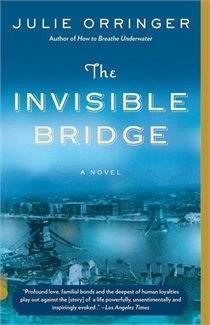
The Invisible Bridge by Julie Orringer
The depth and authenticity of the characters made The Invisible Bridge captivating. The triumphs they achieved, the struggles they overcame or succumbed to, and the emotions they experienced all felt real and believable. The period of the book, which begins in 1937 and continues past the end of World War II, is a familiar one in history and literature but Orringer broadens the scope of the times as Andras bears up against the horrors and uncertainties of being conscripted into the labor battalions of eastern Europe.
I found the book to be engaging and powerful. The story spanned more than a decade, but I didn't feel that the author had to hurry the pace to cover that much time. In fact, the pages were rich with day-to-day details of the characters' lives, in times of relative peace and in the midst of heartache, that made the book convincing. Stories of survivors of World War II and the Holocaust, both fiction and historical accounts or memoirs, are among my favorite books to read and The Invisible Bridge did not disappoint.
Subscribe to:
Posts (Atom)
